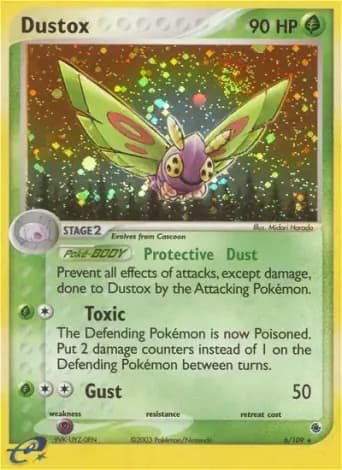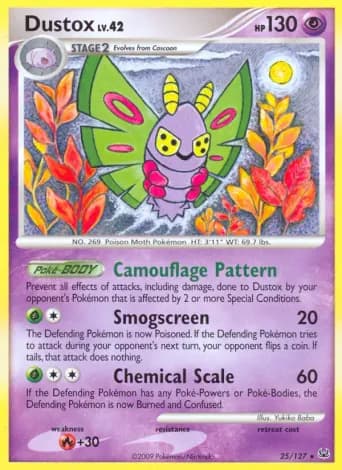
Dustox #25
📉 Dip AlertDustox is card #25 from Platinum, a Rare Pokémon card currently trading near $9.28 for its Reverse Holofoil printing.
Leave the email blank to keep this alert in your browser only. With an email we'll notify you once per crossing — no account needed.
Want a weekly summary instead? Get the market digest by email — no account needed.
By CardLedger Research · Market data updated · Prices from TCGplayer & Cardmarket
Net estimates use each marketplace's default seller tier and typical shipping — fees vary by category, account status and payment method, so confirm current rates before selling.
Dustox #25 has slipped week-on-week. Selling sooner limits downside, while buyers get a value window.
Dustox at a glance
- Rare rarity.
- Short-term trend -12.7% (7d vs 30d).
- Cardmarket trend price €1.15.
- Trades around $9.28 on TCGplayer.
- Platinum, Platinum series, 2009.
Dustox price by printing
Live TCGplayer and Cardmarket values for Dustox #25.
TCGplayer prices, updated 2026/10/26.
- Low
- $3.99
- Mid
- $13.49
- High
- —
- Low
- $1.49
- Mid
- $3.07
- High
- —
Cardmarket pricing (EUR)
Cardmarket data updated 2026/10/26.
Verify the card image and live listings on TCGplayer, Cardmarket or eBay.
Is this Dustox a good deal?
Put any asking price against today's live market value for Dustox #25.
Enter what a seller is asking for Dustox #25. We compare it to today's live market value.
About Dustox #25
Platinum placed Dustox at #25; the Pokémon card entered the market in 2009 within the Platinum series. The card carries 130 HP and Psychic typing, with a Stage 2 designation.
The card is illustrated by Yukiko Baba and currently trades at $9.28 for the Reverse Holofoil printing, with a low-to-high range of $3.99 to —.
Card facts
- Set
- Platinum
- Series
- Platinum
- Number
- #25 / 127
- Rarity
- Rare
- Illustrator
- Yukiko Baba
- HP
- 130
- Type
- Psychic
- Subtype
- Stage 2
- Evolves from
- Cascoon
- Pokédex
- #269
- Released
- 2009/02/11
Dustox attacks, abilities & battle stats
Printed card text and battle statistics for Dustox #25 — the playability layer behind the price.
Camouflage Pattern
Prevent all effects of attacks, including damage, done to Dustox by your opponent's Pokémon that is affected by 2 or more Special Conditions.
Smogscreen
The Defending Pokémon is now Poisoned. If the Defending Pokémon tries to attack during your opponent's next turn, your opponent flips a coin. If tails, that attack does nothing.
Chemical Scale
If the Defending Pokémon has any Poké-Powers or Poké-Bodies, the Defending Pokémon is now Burned and Confused.
Battle stats
- Weakness
- Fire +30
- Retreat cost
- —
- Ability
- Camouflage Pattern
- Attacks
- 2
Dustox price analysis
What drives the current market value of Dustox #25.
TCGplayer tracks 2 print variants for this card: Reverse Holofoil ($9.28), Normal ($2.84).
$9.28 gives Dustox real margin potential, so buy near the low end and sell toward the mid.
$9.28 gives Dustox real margin potential, so buy near the low end and sell toward the mid.
Cardmarket values Dustox at a trend of €1.15, an average sold price of €0.89 and a near-mint floor of €0.05.
Dustox price history & movement
Momentum reads cooling off — a 7-day average of €0.89 against a 30-day average of €1.02 (-12.7%).
Latest daily average €1.00 against a trend price of €1.15.
Our own daily snapshots now cover 4 days for Dustox, with a recorded low of $8.35 and high of $9.28; current value is at 100% of that band.
Daily moves average a volatility of 5.3%, and the largest peak-to-trough drawdown recorded is 0%.
Cardmarket averages
Price fingerprint
Built from CardLedger's own daily snapshots · 4 days tracked · latest
Real recorded values from our daily TCGplayer snapshots — not estimates or back-filled history. Methodology
How much would you net selling Dustox?
Model the real take-home on a [object Object] sale across eBay, TCGplayer, Cardmarket and direct — fees and shipping included.
Selling Dustox at $9.28 nets roughly $7.75 on eBay, $7.80 on TCGplayer, $8.47 via Cardmarket, $7.97 on Whatnot or $9.28 direct — the platform you pick is worth up to $1.53.
High-fee marketplaces reach the biggest buyer pool, while direct and low-commission routes keep more margin but move slower — adjust the widget below for your own shipping and price.
Your sale
Pre-filled with the current TCGplayer market for Dustox #25.
Modelled on each marketplace's default seller tier with your shipping input. Net payout = sale price − selling fees − outbound shipping. Fee figures are estimates (last reviewed October 15, 2026) and vary by category, account status and payment method — confirm current rates with the marketplace. Open the full seller fee calculator to model account tiers and buyer-paid shipping.
Should you grade Dustox?
Model the break-even and PSA 9 vs PSA 10 profit on grading Dustox #25 against today's raw market value.
Grading plan
Pre-filled with the live market value for Dustox #25.
Both-way postage plus declared-value insurance.
Estimated graded values below are a transparent starting point based on the raw price band — edit them with real graded comps before deciding.
At $9.28 raw and $40.00 all-in grading cost, a PSA 10 nets — versus selling raw, a PSA 9 nets —. You need a graded sale of $55.25 to break even on grading.
At your stated grade odds the expected profit is — (-53.8% return on cost basis).
Grading costs, turnaround and grade outcomes vary by service and card. The estimated PSA 9 and PSA 10 values are heuristics, not predictions — always sanity-check against recent graded sold listings before committing. This is a modelling tool, not financial advice.
Dustox within Platinum
Within Platinum it is the #64 most valuable of 89 tracked cards; the set median is $18.33.
That is 49% below the middle of the set — a top-29% position.
The set's top card is Dialga G (#122), valued at $306.36.
What makes Dustox valuable
- Classic-era cards like Dustox (2009) are out of print, so condition drives differentiation.
- Dustox is a Rare, so condition and the specific print variant matter more than raw rarity.
- The Yukiko Baba artwork gives Dustox appeal beyond pure playability.
- steady supply at this price keeps the card accessible to new collectors.
- Dustox is a Psychic card with 130 HP, so demand comes from both collectors and players.
Buying & selling Dustox
- If you are buying to resell, model marketplace fees first — the $9.28 value is pre-fee, and the seller-fee calculator shows the net take-home per platform.
- Track the Cardmarket 7- and 30-day averages (€0.89 and €1.02) to time entries and exits.
- Bulk lots of Dustox can hide condition issues; inspect edges and holo surfaces before paying near the — high.
- For Dustox, confirm the exact print variant before buying: Reverse Holofoil, Normal prices differ, and listings often mix them.
- Platinum was released in 2009; sealed product from this era is limited, so raw singles appreciate with collector demand.
Dustox value questions
What is Dustox #25 worth?
Dustox trades near $9.28 on TCGplayer (Reverse Holofoil), ranging $3.99–—; Cardmarket shows €1.15.
Is Dustox a good investment?
As a classic-era Rare card it is trending down in the short term (-12.7% on the 7-day vs 30-day average). Finite supply supports long-term value.
How rare is Dustox?
Dustox is a Rare card from Platinum (Platinum series, 2009). It sits in a common-to-mid rarity tier, so condition and variant matter more than raw scarcity.
What print variants exist for Dustox?
TCGplayer tracks 2 printings: Reverse Holofoil ($9.28), Normal ($2.84). Prices differ between variants, so always confirm which one you own or are buying.
Where can I buy or sell Dustox?
The main marketplaces are TCGplayer (USD), Cardmarket (EUR) and eBay. Current TCGplayer market is $9.28. When selling, compare net proceeds after fees — eBay and TCGplayer typically charge 9–13%, while direct sales carry lower or no fees.
What affects the price of Dustox?
Four factors dominate: the Rare rarity tier, the classic-era Platinum set pedigree, playability (Pokémon, Psychic), and condition. Artwork by Yukiko Baba also matters to collector demand.
Other Dustox cards
Dustox appears in multiple sets — compare market values.