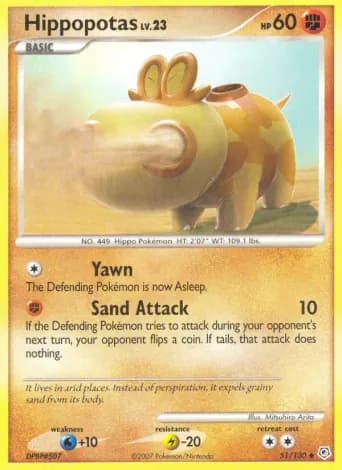
Hippopotas #64
🔥 Hot MoveAs card #64 in Rising Rivals, Hippopotas is a Common Pokémon card worth about $8.99 ungraded.
Leave the email blank to keep this alert in your browser only. With an email we'll notify you once per crossing — no account needed.
Want a weekly summary instead? Get the market digest by email — no account needed.
By CardLedger Research · Market data updated · Prices from TCGplayer & Cardmarket
Net estimates use each marketplace's default seller tier and typical shipping — fees vary by category, account status and payment method, so confirm current rates before selling.
Demand for Hippopotas #64 rose this week. If you're cashing out, this is a strong window; holders can wait for more upside.
Hippopotas at a glance
- Current TCGplayer market value $8.99 (Reverse Holofoil).
- Cardmarket values it at €0.12 (EUR).
- Rarity tier — Common.
- Short-term trend 27.3% (7d vs 30d).
- From Rising Rivals (Platinum), released 2009.
Hippopotas price by printing
Live TCGplayer and Cardmarket values for Hippopotas #64.
TCGplayer prices, updated 2026/10/26.
- Low
- $3.69
- Mid
- $7.64
- High
- —
- Low
- $0.01
- Mid
- $0.31
- High
- —
Cardmarket pricing (EUR)
Cardmarket data updated 2026/10/26.
Verify the card image and live listings on TCGplayer, Cardmarket or eBay.
Is this Hippopotas a good deal?
Put any asking price against today's live market value for Hippopotas #64.
Enter what a seller is asking for Hippopotas #64. We compare it to today's live market value.
About Hippopotas #64
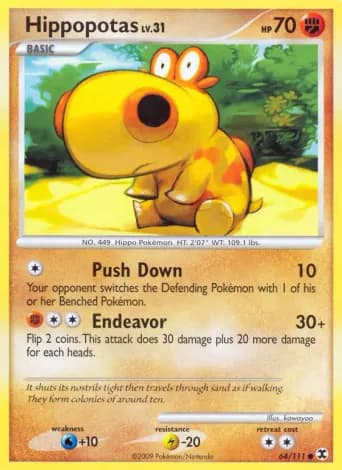
Card #64 of Rising Rivals is Hippopotas, a classic-era Pokémon card from the Platinum series (2009). The card carries 70 HP and Fighting typing, with a Basic designation.
Artwork is by kawayoo; the Reverse Holofoil printing sits around $8.99, spanning $3.69–— between the cheapest and priciest listings.
“It shuts its nostrils tight then travels through sand as if walking. They form colonies of around ten.”
Printed flavour text on the Rising Rivals #64 card.
Card facts
- Set
- Rising Rivals
- Series
- Platinum
- Number
- #64 / 111
- Rarity
- Common
- Illustrator
- kawayoo
- HP
- 70
- Type
- Fighting
- Subtype
- Basic
- Pokédex
- #449
- Released
- 2009/05/16
Hippopotas attacks, abilities & battle stats
Printed card text and battle statistics for Hippopotas #64 — the playability layer behind the price.
Push Down
Your opponent switches the Defending Pokémon with 1 of his or her Benched Pokémon.
Endeavor
Flip 2 coins. This attack does 30 damage plus 20 more damage for each heads.
Battle stats
- Weakness
- Water +10
- Resistance
- Lightning -20
- Retreat cost
- Colorless · Colorless
- Attacks
- 2
Hippopotas price analysis
What drives the current market value of Hippopotas #64.
TCGplayer tracks 2 print variants for this card: Reverse Holofoil ($8.99), Normal ($0.40).
$8.99 gives Hippopotas real margin potential, so buy near the low end and sell toward the mid.
$8.99 gives Hippopotas real margin potential, so buy near the low end and sell toward the mid.
In EUR, Hippopotas trends at €0.12 on Cardmarket (avg sold €0.12, lowest NM €0.02).
Hippopotas price history & movement
Momentum reads heating up — a 7-day average of €0.14 against a 30-day average of €0.11 (+27.3%).
Single-day average: €0.05; Cardmarket trend price €0.12.
Across 4 recorded days the price spanned $8.99–$8.99. The most recent snapshot of $8.99 sits 100% up that range.
Recorded volatility runs near 0% per day, with a maximum drawdown of 0% over the tracked window.
Cardmarket averages
Price fingerprint
Built from CardLedger's own daily snapshots · 4 days tracked · latest
Real recorded values from our daily TCGplayer snapshots — not estimates or back-filled history. Methodology
How much would you net selling Hippopotas?
Model the real take-home on a [object Object] sale across eBay, TCGplayer, Cardmarket and direct — fees and shipping included.
On a $8.99 sale, the take-home differs by platform: about $7.50 via eBay's default tier, $7.54 on TCGplayer, $8.19 on Cardmarket, $7.71 on Whatnot and $8.99 selling directly — a $1.49 spread after fees and typical shipping.
As a common card, Hippopotas sells differently by venue: marketplaces maximise reach, personal channels maximise margin. Use the calculator to weigh reach against take-home.
Your sale
Pre-filled with the current TCGplayer market for Hippopotas #64.
Modelled on each marketplace's default seller tier with your shipping input. Net payout = sale price − selling fees − outbound shipping. Fee figures are estimates (last reviewed October 15, 2026) and vary by category, account status and payment method — confirm current rates with the marketplace. Open the full seller fee calculator to model account tiers and buyer-paid shipping.
Should you grade Hippopotas?
Model the break-even and PSA 9 vs PSA 10 profit on grading Hippopotas #64 against today's raw market value.
Grading plan
Pre-filled with the live market value for Hippopotas #64.
Both-way postage plus declared-value insurance.
Estimated graded values below are a transparent starting point based on the raw price band — edit them with real graded comps before deciding.
At $8.99 raw and $40.00 all-in grading cost, a PSA 10 nets — versus selling raw, a PSA 9 nets —. You need a graded sale of $54.97 to break even on grading.
At your stated grade odds the expected profit is — (-54.6% return on cost basis).
Grading costs, turnaround and grade outcomes vary by service and card. The estimated PSA 9 and PSA 10 values are heuristics, not predictions — always sanity-check against recent graded sold listings before committing. This is a modelling tool, not financial advice.
Hippopotas within Rising Rivals
By market value Hippopotas sits at #64 of 78 in Rising Rivals (set median $27.60).
That is 67% below the middle of the set — a top-19% position.
The set's top card is Snorlax (#111), valued at $999.99.
What makes Hippopotas valuable
- Classic-era (2009) cards have a dedicated collector base and no prospect of new supply.
- Its Fighting typing means Hippopotas has a dual collector-and-player audience.
- With steady supply, Hippopotas is inexpensive to enter and easy to move in bulk.
- Artwork by kawayoo is a factor for collectors who follow specific illustrators.
- Hippopotas is a Common, so condition and the specific print variant matter more than raw rarity.
Buying & selling Hippopotas
- Bulk lots of Hippopotas can hide condition issues; inspect edges and holo surfaces before paying near the — high.
- Rising Rivals was released in 2009; sealed product from this era is limited, so raw singles appreciate with collector demand.
- Track the Cardmarket 7- and 30-day averages (€0.14 and €0.11) to time entries and exits.
- If you are buying to resell, model marketplace fees first — the $8.99 value is pre-fee, and the seller-fee calculator shows the net take-home per platform.
- For Hippopotas, confirm the exact print variant before buying: Reverse Holofoil, Normal prices differ, and listings often mix them.
Hippopotas value questions
What is the value of Hippopotas?
Live pricing puts the Reverse Holofoil print at $8.99 (low $3.69, high —); the Cardmarket trend is €0.12.
Is Hippopotas a good investment?
Short-term momentum is rising (+27.3%). Older print runs tend to be more defensive holds.
How rare is Hippopotas?
Hippopotas is a Common card from Rising Rivals (Platinum series, 2009). It sits in a common-to-mid rarity tier, so condition and variant matter more than raw scarcity.
Does Hippopotas have multiple printings?
TCGplayer tracks 2 printings: Reverse Holofoil ($8.99), Normal ($0.40). Prices differ between variants, so always confirm which one you own or are buying.
Where can I buy or sell Hippopotas?
The main marketplaces are TCGplayer (USD), Cardmarket (EUR) and eBay. Current TCGplayer market is $8.99. When selling, compare net proceeds after fees — eBay and TCGplayer typically charge 9–13%, while direct sales carry lower or no fees.
What affects the price of Hippopotas?
Four factors dominate: the Common rarity tier, the classic-era Platinum set pedigree, playability (Pokémon, Fighting), and condition. Artwork by kawayoo also matters to collector demand.
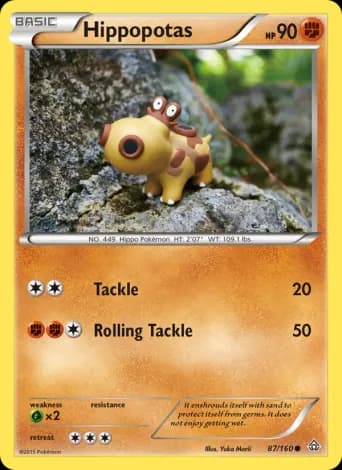
Other Hippopotas cards
Hippopotas appears in multiple sets — compare market values.